


Game based learning only works when the game cannot be won without the learning. Here is what that looks like in practice, and what it produces.
By Julia Rivard Dexter, Co-Founder and CEO, Shoelace Learning,
On September 8, 2026, the OECD published the PISA 2025 results. Reading performance across OECD countries fell to the lowest average ever recorded. One in five 15 year olds is now a low performer in reading, mathematics and science, up from 16% in 2022. Reading across the OECD has dropped 28 points since 2015, which the OECD puts at roughly a year and a half of lost learning. In the United States, reading fell 14 points in three years to its lowest level since the country began taking part in 2000.
One finding inside that report has not received the attention it deserves. The OECD tracked a behaviour it calls hasty reading: students who move through a demanding text once, quickly, and never go back to check anything. That group grew from about 7% of students in 2018 to 11% in 2025.
Read those two findings together and the picture gets clearer. Students are not only reading less. They are reading faster and shallower, and comprehension is what gets left behind. Careful reading is a habit. Habits are built through practice, and they fade without it.
The screen time argument is aimed at the wrong target
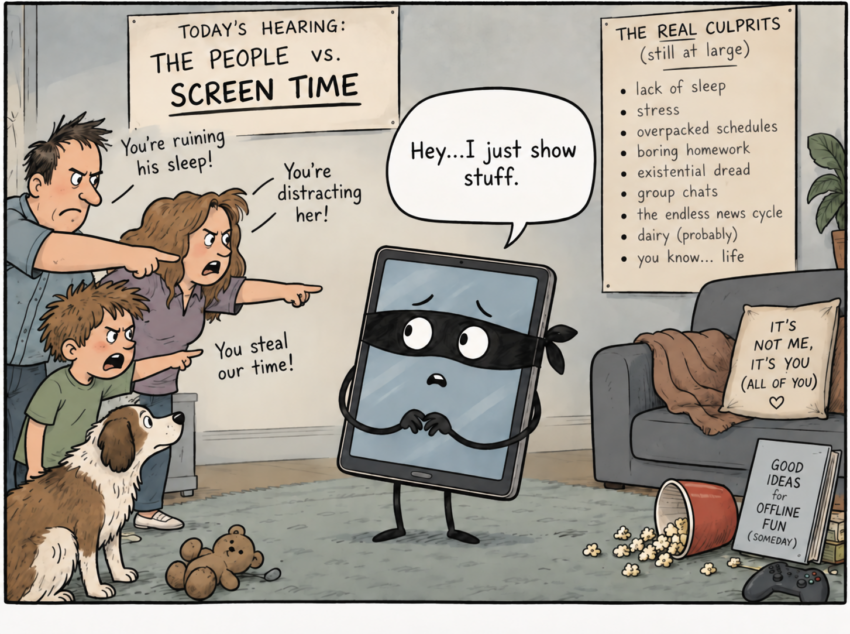
The PISA results landed in the middle of a loud debate about devices in schools, and the report gives both sides ammunition. More than one in four students said classmates were distracted by devices in most science lessons, and device distraction tracked with lower scores in 59 of the 82 school systems studied. Students who used AI chatbots regularly scored about 20 points lower in science than students who did not, though the OECD was careful not to claim cause.
So districts are writing device bans, and we understand the impulse. But the conclusion does not follow from the evidence. The evidence says that unstructured, undesigned screen time hurts students. It does not say that all screen time hurts students.
We have made this argument before. The problem is not that students are on screens. The problem is that our industry has spent two decades shipping products that are thin, boring, or easy to fake your way through, and then calling the clicking that results engagement. When a product is weak, students guess their way through it. That is a product failure, not a screen failure. Our own data on cutting guessing and lifting accuracy shows how much of this is in the designer’s hands.
The right question for a school is not how many minutes. The right question is what happens during those minutes.
The one question every learning game has to answer
Here is the test we would put to any game based learning product: can a student succeed in the game without doing the learning?
For most products, the honest answer is yes. The learning content sits beside the game instead of inside it. Answer some questions, earn some coins, spend the coins on the fun part. Students work out the exchange rate within a week. They learn to pay the reading tax as cheaply as possible, by guessing, so they can get back to the part they actually want. The product reports high usage. The dashboard looks healthy. Very little reading happened.
This is the design failure at the centre of game based learning, and it is a failure of structure, not of effort. If a game rewards anything other than genuine comprehension, students will find it. Looking for the shortest path to the goal is what good players do, which is why we build our mechanics to make accuracy the shortest path.
The fix is not to lecture students about trying harder. The fix is to build a game where the shortest path to the goal runs straight through careful reading.
What that looks like in Dreamscape and Dreamseeker Drift
In our games there are exactly four ways to earn points, and all four require answering questions correctly.
-
- Answer streaks pay 50 points for each correct answer that follows another correct answer. This is reading practice, scored.
-
- Running in Dreamseeker Drift pays about 60 points a minute past 500 metres. Students answer questions to earn the lives a run needs, at Knowledge Orbs during the run, and again after a crash.
-
- Building upgrades in Dreamscape pay 10 points per level, and every upgrade needs both resources and a set number of correct answers before it will finish.
-
- Winning a challenge pays 25 points, and every five questions answered earns a student one challenge token to compete with.
There is no fifth way. Nothing purchasable moves a student up the board. Even the parts of our games that look like pure play sit behind questions.
That structure shows up in the scores. Take twenty minutes of play. A student who reads carefully and gets 9 in 10 right across 60 questions finishes with 2,430 points. A student who rushes and guesses through 120 questions, getting 1 in 3 right, finishes with 735. The second student answered twice as many questions and scored less than a third as much.
The streak mechanic is what creates that gap. A correct answer only pays when the answer before it was also correct. Two right in a row are worth 50 points. Two right with a wrong one in between are worth nothing. Guessing breaks the chain over and over, so a student who rushes spends the whole session rebuilding a streak that never pays.
For the same number of questions, accuracy is worth up to 13 times more than speed. Answering twice as many questions only ever doubles a score. We have written a full scoring guide for teachers and coaches that lays out exactly how points are earned, and what will not help.
One more thing matters here. Accuracy in our games is not a measure of who the strongest reader is. Our learning engine matches content to each student, keeping it hard enough to stretch them and easy enough that they keep going, which we call the Goldilocks threshold. A student working two grade levels below their class sees material pitched to them, not to the class. So accuracy reflects care and attention rather than raw reading ability, and every student competes on effort at their own level.
Twelve years of work, and one recent breakthrough
We have been working on this since 2014. Not on engagement for its own sake, but on the join between what motivates a player and what builds a reader. Most of what we have learned came from watching students find shortcuts we did not anticipate, then closing those shortcuts with better design instead of with rules.
Our most recent step is the biggest one yet. In 2026 we released the Dream Point Booster in both games. It is a meter that climbs when students answer correctly and dips when they do not, and the higher it climbs, the more every in game reward multiplies: faster building upgrades, faster resource collection, stronger power ups. It never lectures. It never says stop guessing. It simply makes careful reading the best strategy available, and it makes that visible in real time.
We compared a full week of play before the meter existed with a full week after it launched in both games, looking only at students who answered at least 25 questions in the week.
| Measure | Before | After | Change |
|---|---|---|---|
| Average student accuracy | 45.6% | 51.1% | +5.5 points |
| Students meeting our fidelity benchmark | 34.5% | 50.1% | +15.5 points |
| Questions likely guessed | 35.3% | 24.3% | -11.0 points |
| Average time spent per question | 5.7 sec | 9.2 sec | +3.5 sec |
The accuracy number matters more than it looks. Our research shows that reading comprehension growth accelerates once a student crosses 50% accuracy on appropriately challenging content. The Dream Point Booster moved the average student across that line, and it moved half of our engaged students into full fidelity play. Likely guessing fell by nearly a third. Students slowed down by more than 60%.
No teacher had to enforce anything. No parent had to intervene. Students changed how they played because the game finally gave them a reason to.
What careful reading produces
We push this hard on accuracy because fidelity play produces measurable reading growth.
In an eight week pilot run with the research arm of Michigan Virtual, 300 students across six districts used Shoelace. 99.7% of licences were activated, against an industry average of 63.4%. 58.7% of students played with fidelity, against an industry average of 5.2%. Of the students who played with fidelity, 41.7% showed at least three months of literacy growth in eight weeks. You can read the full Michigan results here. In our Oklahoma tournament, students playing with fidelity often gained the equivalent of four months of reading growth in four weeks.
Those results come from the same place. Students reading carefully, on purpose, for a sustained stretch of time.
Designing screen time with intention
Comprehension is the skill most at risk right now. Students can get a summary of anything in seconds, and a generation is quietly learning that reading a text closely is optional work. The PISA hasty reader finding is early evidence of that. The AI chatbot finding may be more of it.
That makes practice at careful reading more valuable, not less. And it raises the design standard for education technology rather than lowering it.
We would like the screen time debate to move from how much to what for.
Thirty focused minutes a week on a well designed literacy game, where every reward depends on comprehension, is not the same thing as three hours on a poorly designed one. Treating them as equivalent helps nobody, and the students who lose the most are the struggling readers who need engaging practice the most.
Education needs more technology designed with intention and measured for impact, and less technology designed for the demo. So ask any vendor the question we ask ourselves every time we ship something: can a student win this without doing the learning? Then ask them to show you the data.
If you want to see what intentional design looks like in a classroom, our next Global Reading Tournament runs this October. It takes 30 minutes of student play a week, and every point earned runs through reading.